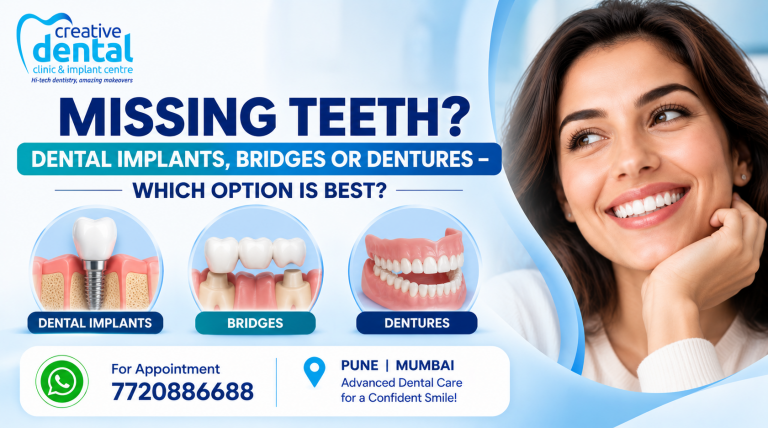
A Complete Guide to Modern Tooth Replacement Options by Dr. Prathamesh Joshi, Creative Dental Clinic & Implant Centre, Pune & Mumbai
Losing a tooth is not just about having a gap in your smile. It can affect the way you eat, speak, and feel about your appearance. Whether you’ve lost a tooth due to decay, gum disease, an accident, or ageing, finding the right replacement can make a meaningful difference to your oral health and confidence.
If you’re searching for the best option for missing teeth, you’ve probably come across three popular treatments: dental implants, dental bridges, and dentures.
But which one should you choose?
The answer depends on several factors, including your oral health, number of missing teeth, jawbone condition, budget, and long-term expectations.
At Creative Dental Clinic & Implant Centre, Dr. Prathamesh Joshi and the dental team help patients explore personalised tooth replacement options designed to restore both dental function and natural-looking smiles.
Let’s understand the differences between dental implants, bridges, and dentures so you can make an informed decision.
What Is the Best Option for Replacing Missing Teeth?
Dental implants, dental bridges, and dentures are all established options for replacing missing teeth. Dental implants are often preferred when a fixed, independent replacement is suitable. Bridges can be a practical fixed solution when neighbouring teeth can support them, while dentures offer a removable option for replacing several or all missing teeth.
There is no single treatment that is best for everyone.
For example:
- If you’re missing one tooth and have adequate jawbone support, a dental implant may be suitable.
- If the teeth next to the gap already need crowns, a dental bridge may be worth considering.
- If you’re missing several or all your teeth and want a removable solution, dentures may be appropriate.
- If you want a fixed solution for multiple missing teeth, implant-supported bridges or full-arch restorations may be considered.
A proper dental examination is essential before choosing the treatment.
Why Should You Replace Missing Teeth?
Many people delay replacing a missing tooth, especially when the gap is not visible while smiling.
However, missing teeth can sometimes lead to problems beyond appearance.
- Difficulty Chewing Food
Missing teeth can make it difficult to chew certain foods comfortably, particularly harder foods such as nuts, raw vegetables, or firm fruits.
- Movement of Adjacent Teeth
When a tooth is lost, neighbouring teeth may gradually tilt or shift towards the empty space.
This can affect your bite and make cleaning certain areas more difficult.
- Jawbone Changes
The jawbone surrounding a missing tooth can gradually lose volume because it no longer receives the same stimulation from the tooth root.
Dental implants may help maintain bone around the implant, although they do not completely prevent age-related or other jawbone changes.
- Changes in Speech
Depending on which teeth are missing, some people may notice changes in pronunciation or speech clarity.
- Reduced Smile Confidence
A visible gap can make some people uncomfortable while smiling, laughing, or speaking in social situations.
Replacing missing teeth can help restore appearance, comfort, and everyday function.
Option 1: Dental Implants – A Fixed Tooth Replacement Solution
Dental implants are one of the most widely used modern treatments for replacing missing teeth.
A dental implant is a biocompatible post, usually made from titanium, that is surgically placed into the jawbone to support a replacement tooth.
After the implant integrates with the surrounding bone, a custom-made crown, bridge, or denture can be attached.
Benefits of Dental Implants
Natural-Looking Appearance
Implant-supported crowns can be designed to closely match the colour, shape, and appearance of your natural teeth.
Improved Chewing Stability
Dental implants provide a stable foundation for replacement teeth, helping many patients chew more comfortably.
Preserves Neighbouring Teeth
Unlike a conventional tooth-supported bridge, a single-tooth implant generally does not require preparation of healthy neighbouring teeth.
Supports Jawbone Maintenance
Implants transmit functional forces to the surrounding bone, which may help reduce localised bone loss compared with leaving the space unrestored.
Long-Term Tooth Replacement
With appropriate oral hygiene, regular maintenance, and healthy surrounding tissues, dental implants can function for many years.
However, implant crowns and other components may require repair or replacement over time.
Are Dental Implants Suitable for Everyone?
Not necessarily.
Dental implants require careful assessment of:
- Jawbone quantity and quality
- Gum health
- General medical condition
- Smoking or tobacco habits
- Oral hygiene
- Bite forces
- Healing ability
Some patients may require additional procedures, such as bone grafting, before implant placement.
Who Should Consider Dental Implants?
Dental implants may be suitable for patients looking for:
- Single missing tooth replacement
- Multiple missing teeth replacement
- Fixed teeth replacement
- Implant-supported dentures
- Full-mouth rehabilitation
At Creative Dental Clinic, patients can discuss dental implant treatment options with Dr. Prathamesh Joshi based on their individual oral health needs.
Option 2: Dental Bridges – A Fixed Alternative to Implants
A dental bridge is a fixed restoration used to replace one or more missing teeth by spanning the space between supporting teeth or implants.
A conventional bridge usually relies on neighbouring teeth for support.
How Does a Dental Bridge Work?
The dentist prepares the supporting teeth, takes impressions or digital scans, and arranges a custom-made restoration.
The bridge is then fitted and secured in place.
Depending on the clinical situation, different bridge designs may be considered.
Benefits of Dental Bridges
Fixed Replacement
A conventional bridge stays in place and is not removed daily like a traditional denture.
No Implant Surgery Required
A tooth-supported bridge may be an option for patients who prefer to avoid implant surgery or are not suitable candidates for implants.
Relatively Shorter Treatment Time
A conventional bridge can often be completed more quickly than an implant that requires healing before the final crown is fitted.
Restores Appearance and Function
A well-designed bridge can improve chewing, speech, and smile aesthetics.
Limitations of Dental Bridges
- Healthy supporting teeth may need preparation.
- Special cleaning is required beneath the replacement tooth.
- Supporting teeth may develop decay or gum problems if oral hygiene is inadequate.
- A conventional bridge does not replace the missing tooth root.
- The restoration may eventually need repair or replacement.
Who Should Consider Dental Bridges?
Dental bridges may be appropriate when:
- One or more teeth are missing.
- Suitable supporting teeth are available.
- Neighbouring teeth already require crowns.
- Implant surgery is unsuitable or not preferred.
Option 3: Dentures – A Removable Solution for Missing Teeth
Dentures are removable appliances designed to replace missing teeth and surrounding tissues.
They remain an established treatment option for patients who have lost several or all their teeth.
Types of Dentures
Partial Dentures
Used when some natural teeth remain. A partial denture replaces missing teeth and gains support from the remaining teeth and oral tissues.
Complete Dentures
Used when all teeth in the upper or lower jaw are missing.
Implant-Supported Dentures
These dentures use dental implants for additional support and retention. Some are removable, while others are part of fixed implant-supported restorations.
Benefits of Dentures
Non-Surgical Option
Conventional dentures generally do not require implant surgery.
Suitable for Multiple Missing Teeth
Dentures can replace several teeth or a complete arch.
Often Lower Initial Cost
Traditional removable dentures generally involve a lower initial investment than implant-supported restorations.
Improved Appearance
Modern dentures can be customised to support facial appearance and create a natural-looking smile.
Limitations of Dentures
- Conventional dentures may move during chewing or speaking.
- Some patients need time to adjust.
- Chewing efficiency may be lower than with natural teeth or fixed restorations.
- Regular cleaning and maintenance are essential.
- Dentures may need relining or replacement as the gums and jawbone change.
For patients who struggle with loose dentures, implant-supported dentures may provide additional stability.
Dental Implants vs Bridges vs Dentures: Complete Comparison
Choosing between dental implants, bridges, and dentures becomes easier when you compare the important differences.
Feature | Dental Implants | Dental Bridges | Dentures |
Treatment Type | Fixed or implant-supported restoration | Usually fixed | Usually removable |
Best For | One, several, or all missing teeth | One or more missing teeth | Multiple or all missing teeth |
Surgery Required | Yes | Usually no | No for conventional dentures |
Natural Tooth Preparation | Usually not required for a single implant | Often required | Usually minimal |
Chewing Stability | Generally high | Generally good | Varies by fit and design |
Jawbone Support | Helps maintain bone locally | Does not replace the root | Conventional dentures do not replace roots |
Initial Cost | Generally higher | Moderate to high | Generally lower |
Treatment Duration | Often several months | Often a few weeks | Varies |
Maintenance | Daily cleaning and reviews | Special cleaning beneath bridge | Daily cleaning and periodic adjustments |
Which option is best?
If long-term stability and preservation of adjacent healthy teeth are priorities, dental implants may be worth considering.
If you want a fixed restoration without implant surgery, a dental bridge may be appropriate.
If you need an affordable, removable replacement for several missing teeth, dentures may be a practical option.
The final choice should be made after a clinical examination.
Dental Implants vs Bridges: Which Lasts Longer?
One of the most common questions patients ask is whether dental implants last longer than bridges.
Both treatments can provide many years of function when properly planned and maintained.
Dental implants are designed to integrate with the jawbone and do not depend on adjacent teeth for support in a single-tooth replacement.
Conventional bridges depend on the condition of their supporting teeth and gums.
However, implant complications, gum disease, decay affecting bridge-supporting teeth, and normal wear can influence how long either restoration lasts.
Neither option is guaranteed to last a lifetime. Regular dental check-ups and proper oral hygiene are important for both.
Dental Implants vs Dentures: Which Is More Comfortable?
Dental implants generally provide greater stability than conventional removable dentures.
Because implants are anchored in the jawbone, implant-supported teeth can feel more secure while chewing or speaking.
Traditional dentures rest on the gums and may sometimes shift, particularly when the jawbone changes over time.
However, well-made dentures can also be comfortable and functional.
For patients with complete tooth loss, implant-supported dentures may offer a useful balance between stability and removability.
What Is the Cost of Replacing Missing Teeth in Pune?
Patients frequently search for:
- Dental implant cost in Pune
- Single tooth replacement cost in Pune
- Dental bridge cost in Pune
- Dentures cost in Pune
- Full mouth dental implants cost in Pune
The cost varies depending on the treatment and clinical requirements.
Factors Affecting Tooth Replacement Cost
Number of Missing Teeth
Replacing one tooth is different from restoring several teeth or a complete arch.
Material Selection
The type of implant, crown, bridge, or denture material influences the treatment cost.
Jawbone and Gum Condition
Patients requiring bone grafting, gum treatment, or other preparatory procedures may have additional costs.
Treatment Complexity
Simple restorations and complex full-mouth rehabilitation involve different planning and procedures.
Diagnostic Requirements
Dental X-rays, scans, and other investigations may be required depending on the treatment.
At Creative Dental Clinic & Implant Centre, patients can arrange a consultation to understand their treatment options and receive an individual cost estimate.
What If You Have Multiple Missing Teeth?
When several teeth are missing, treatment planning becomes more complex.
Depending on the number and position of missing teeth, options may include:
- Multiple individual dental implants
- Implant-supported dental bridges
- Conventional partial dentures
- Implant-retained removable dentures
- Full-arch implant-supported restorations
The aim is to restore chewing function, oral health, and appearance while considering the long-term maintenance of the remaining teeth and gums.
Full Mouth Dental Implants: An Alternative to Conventional Dentures
For patients who have lost most or all their teeth, full-mouth dental implants may be an option.
Full-arch implant treatments use strategically positioned implants to support a complete set of replacement teeth.
Some treatment plans may use four or more implants per arch, depending on the patient’s bone condition, bite, and restoration design.
Potential Benefits
- Improved denture stability
- Better chewing confidence
- Fixed or removable implant-supported options
- Natural-looking smile restoration
- Reduced reliance on conventional denture adhesives
Not every patient is suitable for immediate loading or same-day fixed teeth. Careful assessment is necessary to determine the safest and most predictable treatment plan.
Why Choose Creative Dental Clinic for Missing Teeth Replacement in Pune & Mumbai?
Replacing missing teeth requires more than choosing a dental product. It involves understanding the patient’s oral health, functional needs, appearance, and long-term expectations.
At Creative Dental Clinic & Implant Centre, Dr. Prathamesh Joshi and the dental team focus on individualised dental treatment planning.
Personalised Treatment Recommendations
Patients can discuss the advantages and limitations of implants, bridges, and dentures before making a decision.
Implant Dentistry and Smile Restoration
Creative Dental Clinic offers consultations for dental implants, smile makeovers, and full-mouth rehabilitation.
Focus on Function and Aesthetics
A successful tooth replacement should not only look natural but also support comfortable chewing, speech, and oral hygiene.
Convenient Locations in Pune & Mumbai
Creative Dental Clinic serves patients in Hadapsar, Dhankawadi, Kasba Peth, and Mumbai.
Dental Implants and Tooth Replacement for NRIs Visiting India
Many NRIs explore dental treatments during their visits to India.
If you live in the UAE, UK, USA, Canada, Australia, or another country, it is important to understand the treatment timeline before travelling.
For example:
- A dental bridge may require multiple appointments over a relatively short period.
- Conventional dentures require impressions, fitting, and sometimes adjustments.
- Dental implants often involve healing periods between treatment stages.
- Full-mouth rehabilitation may require more extensive planning and follow-up.
For NRI patients considering dental implants in Pune, discussing travel dates, treatment stages, and long-term maintenance requirements in advance can help avoid unnecessary complications.
Book Your Dental Consultation Today
Creative Dental Clinic & Implant Centre
Locations: Hadapsar, Dhankawadi, Kasba Peth – Pune | Mumbai
Call / WhatsApp: 7720886688
Website: www.creativedentalclinic.in
Restore Your Smile. Rediscover Your Confidence.